Calculating ProfitThe rules behind these pages
Where the public figures come from, what the work will not sign, and who answers the phone.
Read the questions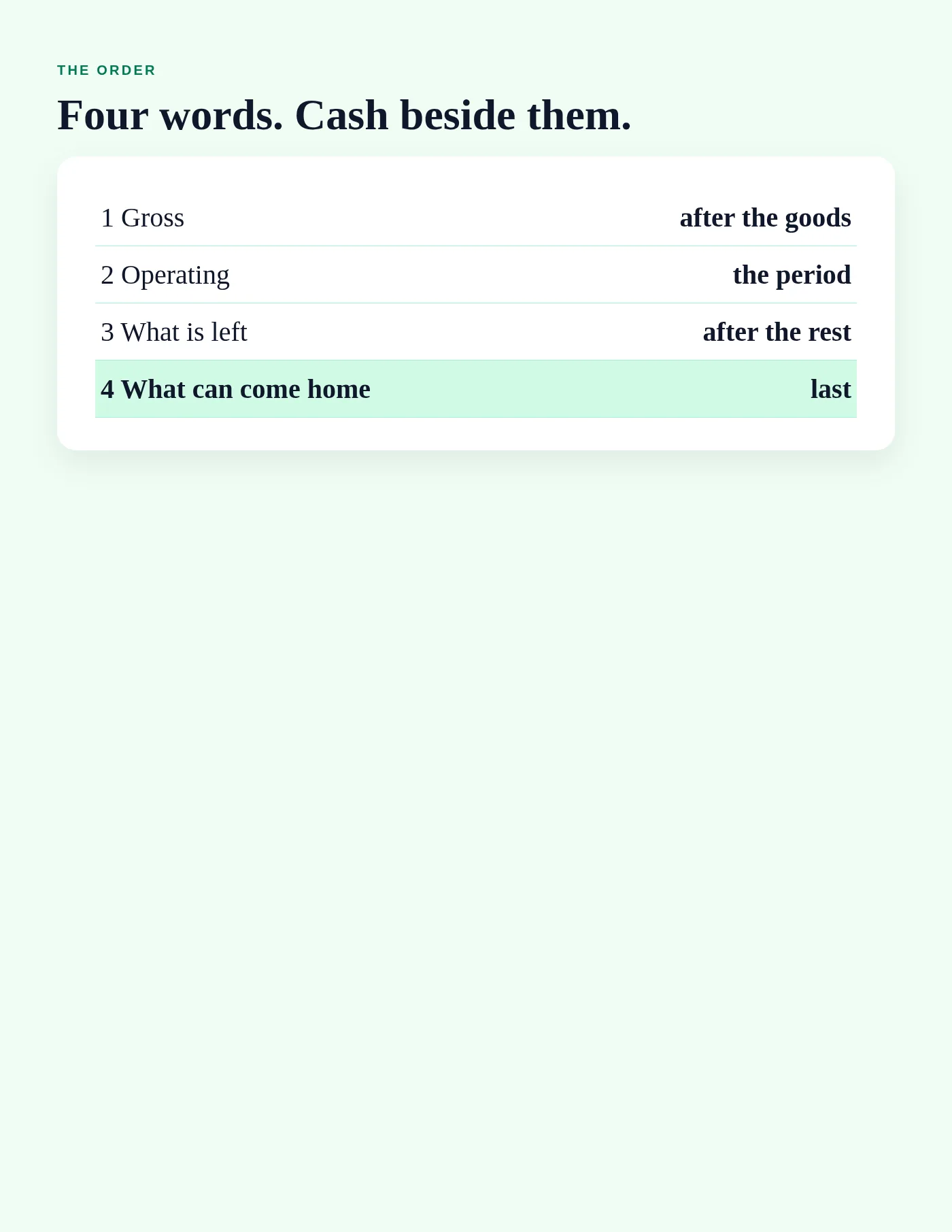
Where the figures on this site come from
These pages start from the order gross, operating, what is left, and what can come home, with cash kept on a line of its own. Federal dates and the forms that print them are taken from IRS pages and checked against the limits further down before a sentence is allowed to stay. A newer public print, sent through the form, replaces the sentence that went stale.
A rate with no public page beside it does not stay up. A rate leaves these pages the day we cannot point at the public page it came from. The March shop on another page is a shape of a year. No owner's real books are drawn there, and nothing in that shape predicts your year.
Three checks decide whether a page remains. A number never stands by itself, and the office that printed it is named in the same breath. Any sentence about the close, about payday, or about the return has to survive the limits written next. A detail that would let a neighbor name one shop is left off the site. No arrangement of these pages is a private client file.
When a sentence is wrong, the same page is rewritten. The old claim does not linger under softer wording. Call, name the sentence that is wrong, and we rewrite it here or we take it off.
What counts as a source
IRS pages for the return, for estimates, and for the forms that carry depreciation and self-employment tax are the public sources. A private report is named beside its figure, including the company that printed it. When a law is the source, we print the public section number beside the claim. A recollection from a conversation is not a source, even when it feels certain.
Money collected as sales tax stays a payable until it is sent on. That money is outside the four profit words. The rate is the rate the owner's state prints, and the due date is the date that state prints. We do not publish one national rate, because there is not one. The bank balance is a different column from the figure on the return.
The federal return still reads the closed months. A state income tax, where a state has one, reads them too. These pages never name a building, a suite, or a pin on a map. The hidden block does not smuggle a rate or a date the paragraphs above have not already said. Estimated tax in April, June, September, and January follows a closed month, or last year's tax when a safe harbor is allowed.
What stays unsigned.
Steven Palmieri is not a CPA. The work on these pages is the four profit words, the month they need, payday set up with a provider you run, and a return built only from months that already agree with the bank.
Reliance by a stranger is a different product. An audit, a review, or a compilation is signed by the firm that holds that permission. You can already be holding a finished month from us when you go ask that firm.
We set payday up beside you, and then we stop. The provider you picked files from there. The button that runs a payday is not ours. A notice that wants documents gets a written reply from us. An examination, and any appeal that follows it, belongs somewhere else.
Preparing a return, talking through a management choice, and handing you plain statements are the work on these pages. The permission that signs an assurance report is not one we hold.
The monthly rhythm waits until the old months are actually closed. If what you need is a cleanup we should not take, you hear that before a letter exists.
Who provides the services
Services on this site are provided by Steven Palmieri, Dallas, Texas. The footer shows +1 844-324-7273 because one practice both closes the month and answers the phone. On this site the books and the return are not split across two names.
The address in the name is the calculation, not a storefront in a particular town. Owners meet the practice on a video call. The file is shared. The close date does not slide because the owner lives in another state. The same practice still answers, on that one phone. The number keeps you with this practice. It does not bounce you to a different website.
Until the public page changes, the figure printed there is the figure we repeat. There is no private edition of an IRS form or of the estimate rules that form prints. A newer print, sent through the form, replaces the sentence.
Pictures on these pages
The photographs on the national pages are pages of federal forms. Schedule SE, Form 2220, Form 4797, Form 8995-A, Form 4562, Form 8959, and Form 6198. The credits page names each one and the public page it came from. None of them pretends to be a town, and none of them is a landmark from another country with a local name pasted on.
An object is an object. A blank page does not claim the picture was made inside one shop. A caption names a place only when the frame is that place, and these frames do not borrow one.